Edited by Pratik Kanjilal
Lagaan turns 25
Spotify India marked the anniversary of the landmark film with a show about its music album, which opened the doors of perception for a postcolonial generation. The Indian-Chinese actor Meiyang Chang anchored the show featuring Ashutosh Gowariker, Aamir Khan, AR Rahman and Javed Akhtar. Not one of those mutual back-scratching sessions that Bollywood is known for, it revealed the back stories and challenges of making the songs for an unusual film which mashed up cricket, Indian rustics, British colonial officers, an infatuated Englishwoman, songs of nature and of resistance, and a religious song which is not addressed to any known god.
Challenges? Akhtar points out that every song is sung by the village en masse ― even AK Hangal, who depicted unmerited adversity all his life, sang. So much singing in unison constituted an existential crisis for the lyricist.
A surprise: the marching song ‘Chale Chalo’ was originally planned as ‘Nasha Nasha’ ― Gowariker and Khan loved the phrase, but Akhtar put his foot down. Later, when a documentary on Lagaan was made and titled Chale Chalo, he reminded them that it could have been named Nasha Nasha.
A delightful insight: Rahman lights a candle in his studio when he composes. He needs something natural, in a room full of machines.
To see the show on YouTube, click the still below:

Iran conflict paused, but damage to India’s self-image done
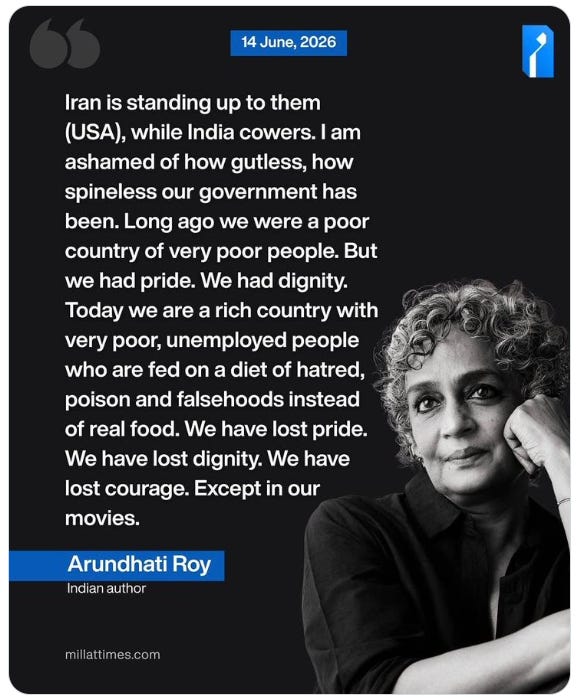
With a memorandum of understanding signed, an Iran-US treaty seems to be possible in two months. Hard to be certain, though, when deals have been declared to be imminent so many times, and then melted away like gas on the wind. What’s certain is that Indians are not happy about the performance of their government in this matter. The opinion that Arundhati Roy articulates is not restricted to liberal elites.
This is the collateral damage of remaining unmoved by collateral damage. Three ships were attacked by the US, and though scores of sailors were rescued from the sinking ships engulfed in fire, some were not so lucky. Three Indian merchant mariners on board a vessel which was trying to run the US blockade of the Strait of Hormuz were killed when a US missile struck its engine room. The Prime Minister held his peace, and when he met Donald Trump in France, he held his peace even more frantically, while the US president said friendly, fruity, meaningless things about him.
In earlier and better times, the Indian press would have campaigned for justice for the bereaved families of the sailors. Now, the press did not raise an outcry, following the lead of the PM. In reaction, even the extensively mustachioed General GD Bakshi, for two decades a permanent fixture in the studios of pro-BJP TV anchors, has turned against the government:

Bakshi says that the US attacked ships crewed by Indians because India keeps saying that the US is a friend. It does not attack Russian or Chinese vessels. Suhasini Haidar notes in The Hindu that instead of expressing regret for Indian lives lost, Marco Rubio seems to be reaffirming the right of the US military to attack vessels which do not follow its orders. This could have implications for India’s zone of influence in the Indian Ocean.
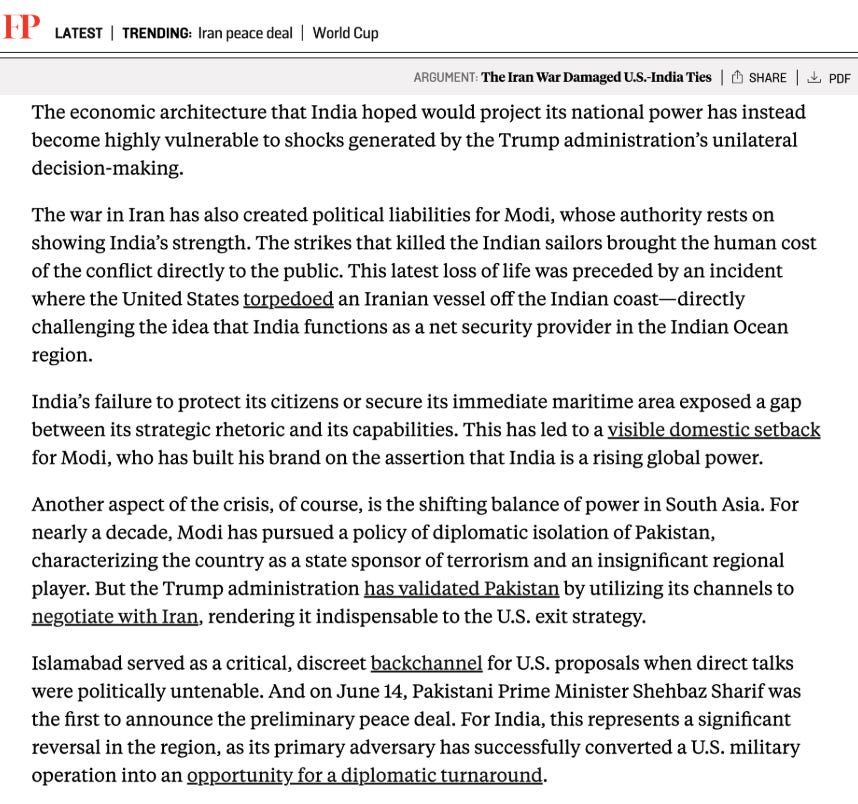
In Foreign Policy, Sushant Singh of Yale writes: “The US was once India’s most trusted strategic partner, but that trust has eroded… What if the current disruption is not an aberration linked to a single presidency but rather a permanent structural shift in US behavior?” Meaning, there’s no future in trying to wait out a presidency.
In earlier diplomatic crises, Manmohan Singh acted decisively
Looking back, two events in the closing years of the Manmohan Singh government offer a sharp contrast. In February 2012, two Italian marines aboard the Italian-flagged tanker MV Enrica Lexie opened extended fire without provocation on a fishing boat in international waters off the Kerala coast, killing two Indian fishermen. Indian authorities arrested the marines, charged them with murder under Indian law, and detained them in India. It became a jurisdictional matter involving the International Tribunal for the Law of the Sea and the Permanent Court of Arbitration, and has become a precedent in maritime law. The Italian marines were freed on payment of reparation to the families of their victims, and the assurance that they would be tried in Italy.
In December 2013, Devyani Khobragade, India’s Deputy Consul General in New York, was arrested for alleged violation of visa conditions concerning her domestic help. The manner in which she was treated, in breach of diplomatic immunity, raised the hackles of the Manmohan Singh government ― she was handcuffed when she was dropping off her daughter at school, aggressively strip-searched, and locked in a cell with common criminals. India responded sharply to what it perceived to be a deliberate government-to-government insult. The concrete barricades protecting the US Embassy, which would even stop a speeding armored car, were removed, along with other security equipment provided by the Indian authorities. The airport passes of US diplomats and their families were revoked, and the embassy’s import licenses were cancelled.
Beautiful man!
India’s relations with the US after the killing of three merchant mariners offers a stark contrast. PM Modi met President Trump at the G7 gathering in Evian-les-Bains, France, and Trump described him as “the most beautiful-looking man”. He went on: “We have the best relationship. We cannot be closer than we are. Would you say that, sir? I don’t think we can be any closer.” He also called him a killer negotiator in ongoing trade talks. In this convivial atmosphere, PM Modi could not bring up the matter of the death of Indian mariners, could he? Couldn’t he?

India’s mainstream media has not pursued the story of the three slain sailors with the intensity of outrage that was palpable during the diplomatic incidents in Manmohan Singh’s time. Indian news analysts and comedians on YouTube have made up for it, and foreign channels have followed the human story. Al Jazeera, for instance, stayed focused on the collateral damage ― families of the slain ― rather than the geopolitics.

Indian sailors in the Gulf are themselves asking why only Indian ships were being attacked ― and why they were being drawn into a conflict which does not concern them. Is it because India is currently in a position of weakness?
With Melody, Modi fares better than Trump
In other G7 news, Indian PM Modi has reason to secretly rejoice. Donald Trump, who praises and bashes him alternately and whimsically, is catching heat from just about the entire cabinet of Giorgia Meloni for saying that she had “begged” for a photo-op with him. She has made it clear that neither she nor Italy begs, and a big chill is besetting US-Italy relations.
Exactly a month ago this weekend, PM Modi visited Meloni and presented her with a bag of Melody candy from India, and they made a video about it. Melodi is a cupola of Meloni and Modi, which was coined when they first met. The candy episode was cheesy and corny, but the video became viral and Meloni was happy to own the publicity. In one matter, at least, Modi has scored over Trump. Just one.
Vikram Seth translates Iqbal’s Ek Arzoo for IHF
In an article on our website, Anuradha Luther Maitra presents Allama Iqbal’s Ek Arzoo in a new translation by Vikram Seth. Composed before 1905 and published in his first collection, Bang-e-Dara, in 1924, it is part of Iqbal’s early lyrical work. It reflects disillusionment with the crowded modern world and a yearning for solitude in the midst of nature, sentiments which were deeply felt by the European Romantics. The poem does not ape them, but Iqbal, who studied at Cambridge, UK, and Munich and Heidelberg in Germany, was probably moved by their work.
Delhi court supports press freedoms in landmark case
A landmark case concerning the suppression of independent media in India has drawn to a close ― well, almost. The Delhi High Court has quashed proceedings against the left-wing organization NewsClick ― which covers issues and platforms voices which are sidelined in mainstream media ― denouncing the government’s “gross abuse of the law”. In 2020, NewsClick was accused of securing funding from a US body while inflating its share value to evade a cap on foreign investment in digital media. The Enforcement Directorate launched a money laundering probe against its founder Prabir Purkayastha, a noted rationalist.
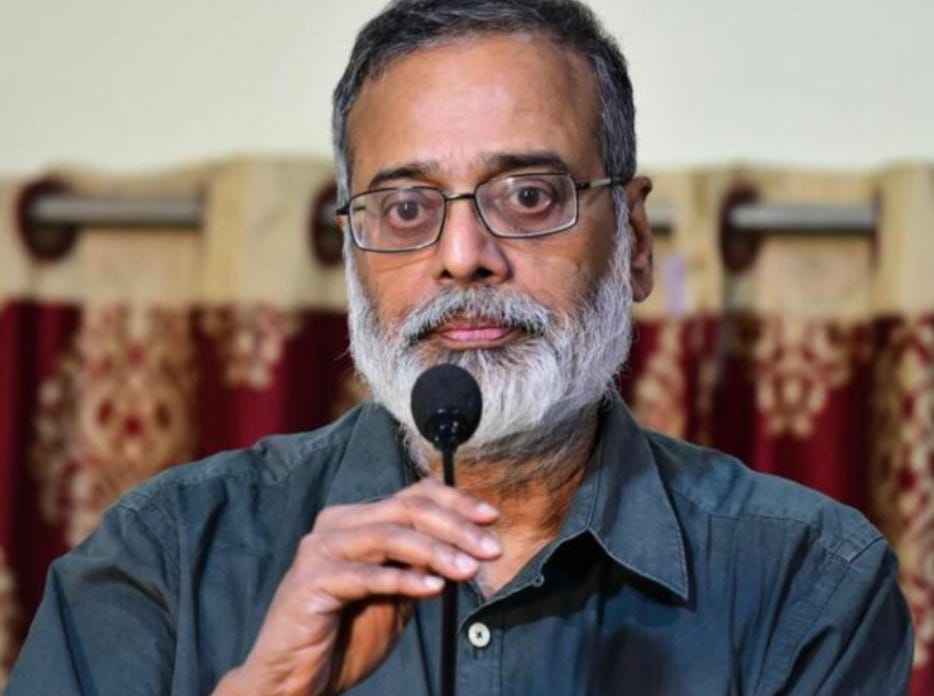
Prabir Purkayastha
The government applied the spurs in 2023, shortly after an imaginative and impressionistic article about American investor and left-wing activist Neville Roy Singham appeared in the New York Times. It claimed that Singham, who is close to the Chinese Communist Party, was funding news organizations like NewsClick to propagate China’s point of view. The case against NewsClick was quickly escalated to a national security matter. Purkayastha was taken into custody, over 100 staffers were scrutinized, and the organization was forced to suspend operations. The whole affair is now revealed to have been an attempt to stifle independent media. However, the government will appeal in the Supreme Court.
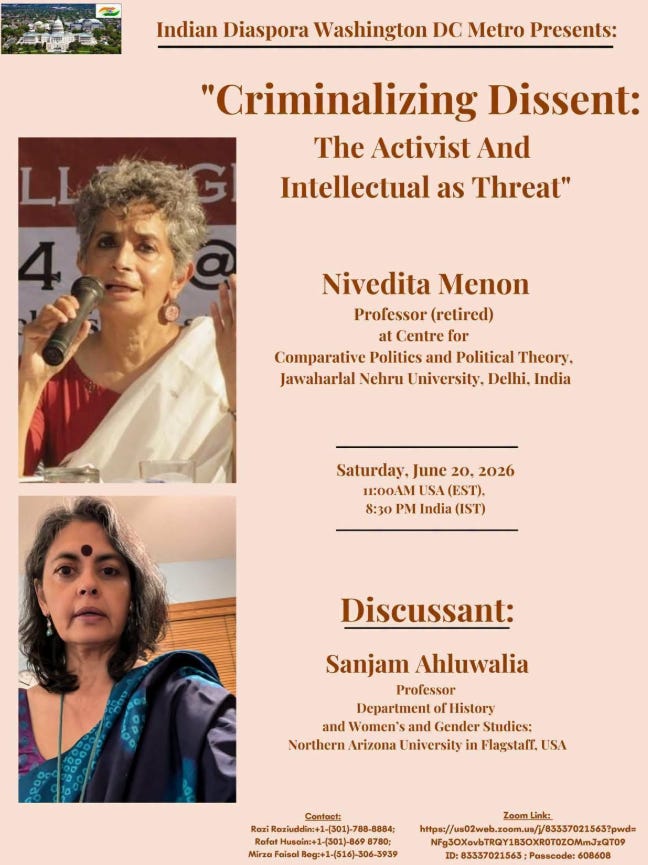
On that note, there’s a discussion tomorrow, Saturday, at 11 am EST on the criminalization of dissent and the witch-hunting of activists and intellectuals in India, featuring Nivedita Menon of JNU and Sanjam Ahluwalia of Northern Arizona University.
Zoom: https://us02web.zoom.us/j/83337021563... ID: 83337021563 ; Passcode: 608608
Once more, with feeling, Penguin India flees in disarray
Penguin Random House India has disappointed readers and the world of publishing yet again by declining to distribute American graphic journalist Joe Sacco’s new book reported from Muzaffarnagar, The Once and Future Riot. The author did not agree to make changes to the book ― which is being read worldwide ― in order to risk-proof the publisher. Sacco spoke to Sidharth Bhatia about Penguin’s corpse-cold feet here. Earlier, Penguin had earned ignominy for capitulating to charges of hurting religious feelings and agreeing to pulp Wendy Doniger’s The Hindus: An Alternative History ― again, a book which was available the world over.
Short takes
At an India alliance meet, Rahul Gandhi positioned the Congress party as a resistance force rooted in the freedom struggle. The tacit message is that India is again engaged in a battle for freedom.
India’s population growth has fallen below the replacement rate for the first time recorded. While slower population growth is good news, India is not prepared for the end of the ‘demographic dividend’ ― with a greying population, fewer people of working age and no system for care-giving.
Ace pistol shooter and coach Jaspal Rana has died aged 49, following a severe heart attack that remained to be fully treated.
A Boston judge struck down the $100,000 charge imposed by the Trump administration on H-1B visas, reading it as an unauthorized tax. It has been reinstated for the duration of an appellate process.
In The Guardian, Jayati Ghosh of UMass Amherst is among economists like Joseph Stiglitz and Thomas Piketty who offer political leaders and administrators a roadmap to a better world ― which is not measured by growth alone.
Mukesh Ambani’s Reliance Jio Platforms has filed for an IPO in Mumbai to raise $3.8 billion. Jio is the world’s second-biggest single-country telecom company and has Google and Meta among its investors. The IPO will finance the payoff of Jio’s $2.92 billion debt.
Indian economist Jean Drèze honored in Paris
Belgian-born Indian welfare economist, policy influencer, activist and self-designated jholawallah Jean Drèze received the Global Inequality Research Award at the World Inequality Conference at the Paris School of Economics on June 5. The event was jointly organized by the World Inequality Lab and Sciences Po’s Centre for Research on Social Inequalities (CRIS). The World Inequality Database says that he was honored for his outstanding work on the measurement of poverty and inequality in India which, as he pointed out at the ceremony, BR Ambedkar had called a “museum of inequality”. “India has all possible varieties of inequality — not only astronomical economic inequality, but also the caste system, huge gender disparities, massive disparities in access to education, and so forth,” Drèze said. “The silver lining is that India also has a rich history of resistance to inequality.”
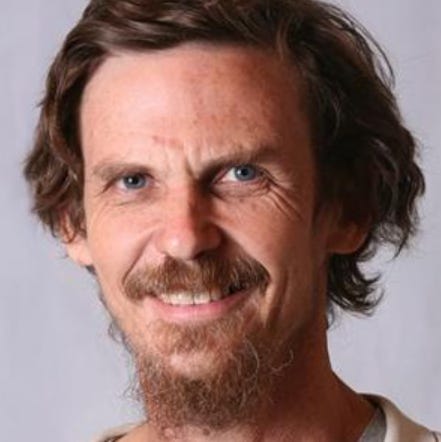
Drèze was one of the prime movers behind the Mahatma Gandhi National Rural Employment Guarantee Act (MGNREGA) of 2005, which gave rural workers a safety net via a guaranteed income, offered marginalized people a measure of autonomy amidst the entrenched hierarchies of rural society, and reduced migration to the cities. It also created permanent civic infrastructure, and the World Bank called it “a stellar example of rural development.” MGNREGA was replaced by the Modi government by the VB–G RAM G, which sounded like a salutation to Lord Ram as it deleted the legal guarantee of work.
Drèze had famously noted that it would take 100 daily wage workers a million years to generate the wealth of Adani. In related news, Democrats are displeased about the Department of Justice’s move to close proceedings against Adani in the US.
The hidden cost of Asia’s data center boom
The Asia Society’s Osborn Elliott Prize for Excellence in Journalism on Asia has gone to Vivian Wang of the New York Times, but a special citation recognizes the work of newsrooms located in Asia or focused on the continent. They included the Earth Journalism Network, which has supported regional media like Down to Earth in India and The Climate Watch in Bangladesh in the collaborative project ‘Dark Side of the Boom’, which estimates the environmental cost of data centers in Asia. Corporations in the affluent countries leading the AI soliton are facing community resistance to data centers, which guzzle water and spew heat, and are outsourcing their business to Asian countries like India whose climate and resources are already stressed. Incidentally, Mumbai’s water supply is down to reserves for one month and in Pune, municipal water will flow only every other day.
And there’s the cost of recycling your cool threads
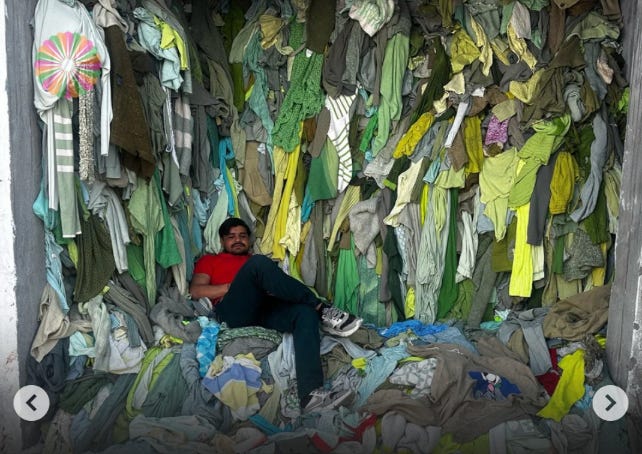
The garment recycling hub of Panipat
AP has reported on the effects of critical heat exhaustion in textile factories in Surat, Gujarat, whose products are used to make clothing the world over ― and branded and sold in stores and boutiques in the US and Europe. And when you’re tired of them and put them in recycling, they find their way back to India ― to Panipat, which processes thousands of tonnes of the world’s waste cloth every day, mostly at informal facilities. It’s a hazardous industry, whose workers are paying the human cost of overconsumption and wastefulness as signals of affluence in the West.
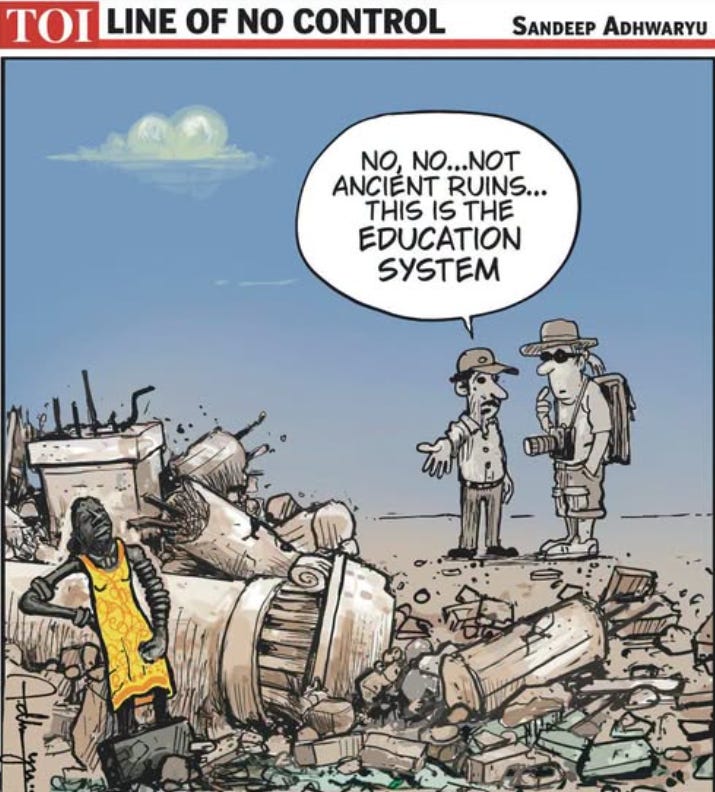
Cockroach, textbook, dancing girl ― the battle over education continues
Education remains a hot-button topic in India. The education minister, who has presided over a slew of examination scams, remains steadfastly in office, while the Cockroach Janta Party ― which is still a popular movement rather than a political party ― continues to agitate for his resignation in Delhi, Pune, Amritsar, Hyderabad, Bengaluru and Jaipur. Their concern is the plight of millions of students who must retake compromised exams, and their next protest is in Jantar Mantar tomorrow, June 20. Today, they have demanded the government must pay Rs 10 million as compensation to the family of every student who died by suicide following the paper leak. There’s an international dimension to this education scam too: the scrutiny of Indian students applying for courses in the US, UK and Australia has been tightened, because Indian degrees are no longer completely trusted.
In an excellent example of shooting the messenger, since the medical college entrance test papers were leaked on Telegram, the app is being blocked in India from June 16 to 22 ― apparently to keep the re-test safe. Telegram has wryly suggested that roads should be closed, too, in case someone is speeding. But the government is above all that ― question papers are being delivered to test centers by military aircraft.
Half-impudent dancing girl causes a flutter
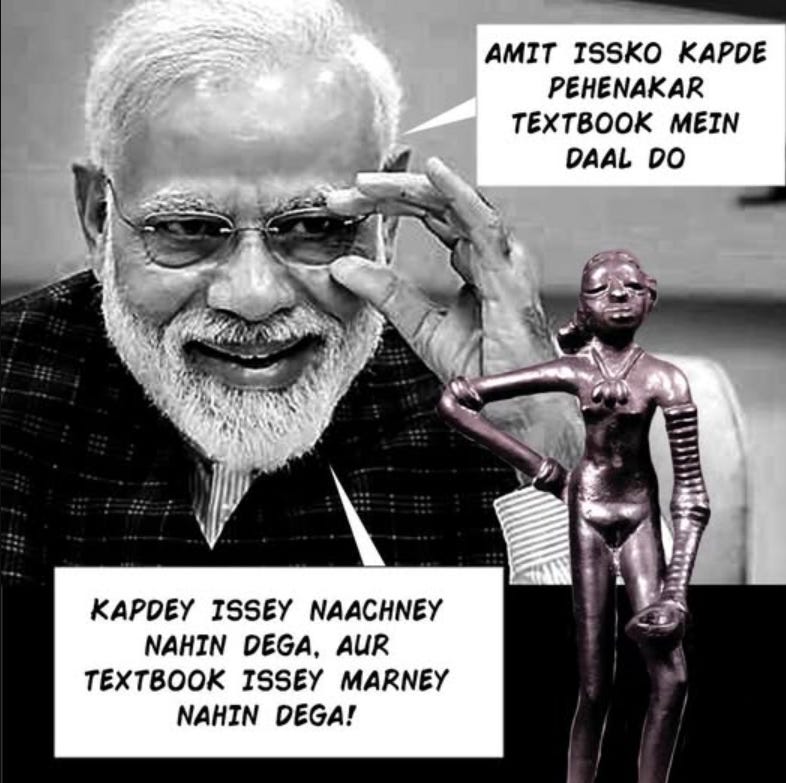
“She’s about fifteen years old I should think, not more, but she stands there with bangles all the way up her arm and nothing else on. A girl perfectly, for the moment, perfectly confident of herself and the world. There’s nothing like her, I think, in the world.” That’s how Mortimer Wheeler, Director-General of the Archaeological Survey of India, had described the ‘dancing girl’ of Mohenjo-daro, a little bronze figurine that’s one of the most sophisticated examples of prehistoric art, and as intriguing as the Mona Lisa. His predecessor John Marshall had called her masterful pose “half-impudent”. For Indians, she is the face of the Indus Valley civilization and has always been depicted in school textbooks in the nude ― as she was found.
But the Indus Valley is history. We are in Ram Rajya. So in Madhurima, the standard Arts textbook for Class 9, the dancing girl was to be censored with clothing. But after a row, the authorities decided to return her to a state of nature, amidst speculation that Khajuraho and Sravanabelagola could be wrapped in saffron next. The Wire reports that the government has tried to clothe her earlier, too, and the results were too horrible to behold:
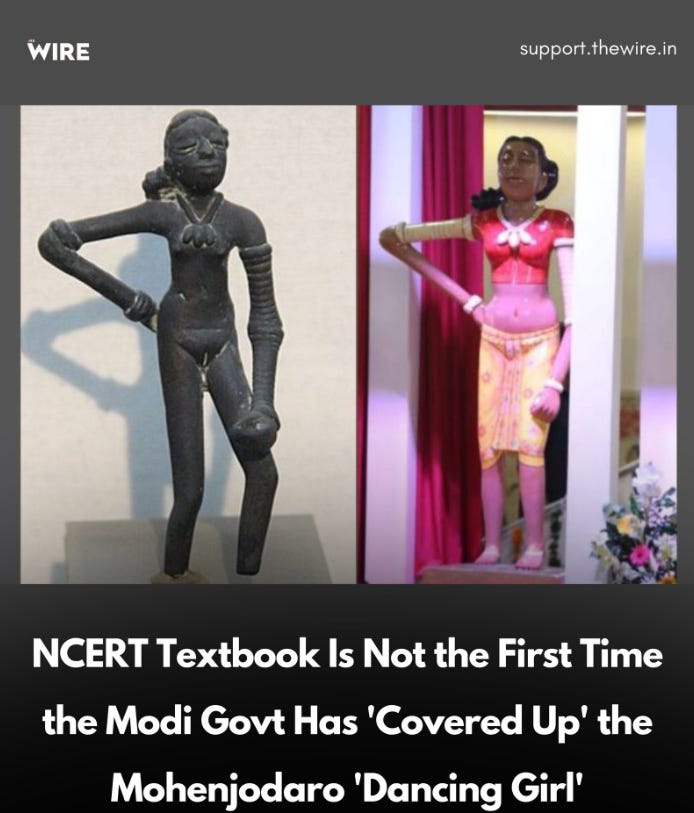
Meanwhile, graphic artist and Pao Collective headman Orijit Sen has retrofitted the dancing girl into a classic Ajit joke: